
Rotary-Kiln Carbonization Systems: What to Define Before Requesting a Quote
What to define before you ask for a rotary-kiln carbonization quote: feedstock, moisture, capacity, internal or external heating, gas use and exhaust limits.
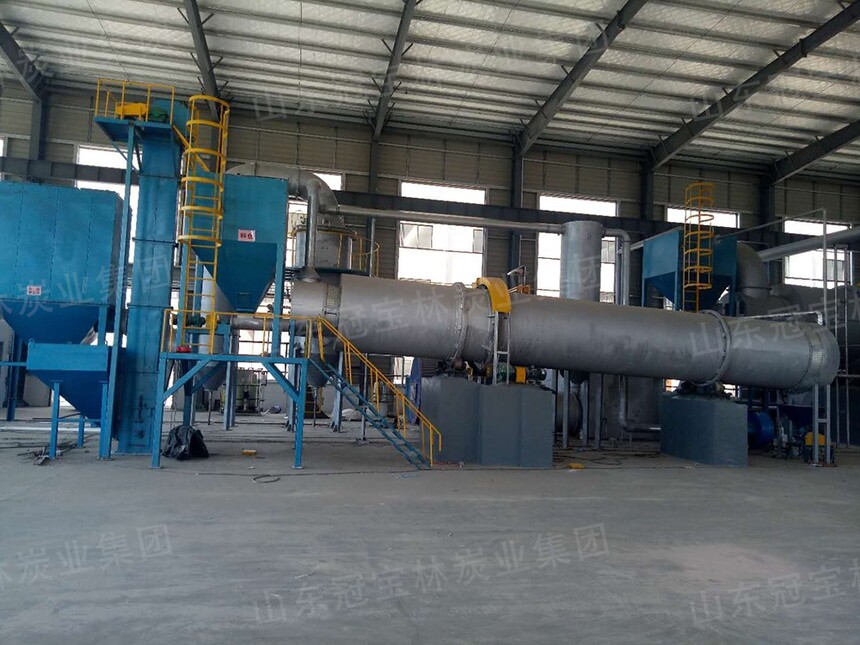
A carbonization kiln inquiry often arrives as a single line: "Please quote a 20 t/day carbonization furnace." We can give a budget figure from that, but it won't hold. Two kilns with the same daily rating can differ a lot in length, heating method, sealing and gas handling, and the reason is almost always the feedstock.
Below is what we ask for before we size a continuous rotary-kiln carbonization system. Send it with the first email and the first quote will be much closer to the final one.
What does a rotary-kiln carbonization system actually do?
It heats a carbonaceous feedstock to high temperature with little or no oxygen, driving off volatiles and leaving char. That char is either the product or the feed for a separate activation stage.
Our Rotary-Kiln Carbonization System runs continuously, under oxygen-free or oxygen-limited conditions. The listed duties are bituminous-coal carbonization or coking, biomass carbonization, and organic-waste carbonization, with sludge and circuit boards as examples. The published capacity range is 3–50 t/day.
Carbonization is not activation. If your end product is activated carbon, the char still has to go through an activation step, for example in a rotary-kiln activation system. Some biomass projects combine both stages in one line; we covered that case in Biomass to Activated Carbon: One-Step Carbonization and Activation.
Which feedstock details change the kiln design?
Feedstock type, moisture, particle size and volatile content change the design more than anything else. Ash and contaminants matter too, especially for waste streams.
Coconut shell, wood chips, bituminous coal and dewatered sludge behave very differently in a kiln. Sludge sticks and needs drying first. Coal can swell. Light biomass takes up volume and gives off a lot of gas. Circuit boards bring plastics and halogens into the off-gas, so exhaust treatment gets more attention than the kiln shell.
What we'd like to see:
Feedstock name and source, and whether it is a single material or a mix
As-received moisture, and whether you can dry it before the kiln (we also supply rotary dryers)
Particle size range, or a photo next to a ruler
Proximate analysis if you have it: moisture, volatiles, ash, fixed carbon
Anything unusual: chlorine, sulphur, heavy metals, oil content
A lab report is better than a description. If you have no data yet, a few kilograms of sample for testing beats guessing. See our pilot testing and project planning service.
How should you state the capacity?
State it as dry feed per day and say what the char is for. "20 t/day" means little until we know whether that is wet feed, dry feed or char out.
Because moisture and volatiles leave the kiln as vapour and gas, char output is much lower than feed input. The ratio depends on the material, so we won't put a figure on it until we have your analysis or test results. Tell us your operating hours as well. A line running 24 hours, 330 days a year is sized differently from one running a single shift.
Internal heating or external heating: which one do you need?
Our carbonization kiln is offered with either internal or external heating. The choice depends on your feedstock, the char quality you need and what you plan to do with the off-gas.
| Point to decide | Internal heating | External heating |
|---|---|---|
| Heat transfer | Heat applied inside the kiln | Heat passes through the kiln shell |
| Contact with combustion gas | Material is exposed to it | Material is kept apart from it |
| Typical question to settle | Is some oxidation of the char acceptable? | Is a cleaner, separate gas stream worth the indirect heat path? |
| What we need from you | Target char quality, feed size | Target char quality, how the off-gas will be used |
We'll recommend one after we review the feedstock. If your team already has a preference, say why, because the reason tells us a lot about the product spec.
Can the combustible gas heat the kiln?
Usually part of it can. Carbonization releases combustible gas, and some of it can supply heat to the equipment. Surplus heat may go to hot water or steam.
How much is left over depends on the feedstock, so we don't promise a heat balance before testing. For sites that want steam, there is a separate Biomass Carbonization and Steam Co-Generation System. It burns the gas in a combustion chamber and sends the flue gas through a waste-heat boiler. Its published range is 3–50 t/day of carbonization feed and 0.5–10 t/h of steam. If you need steam, give us the pressure, the flow and how many hours a day the steam is used.
What should you tell us about the site and emissions?
Tell us the destination, available fuel and power, the local emission limits you have to meet, and the space you have for the line.
The system includes integrated exhaust treatment designed to meet applicable national emission standards. Your local permit may ask for more, or for different pollutants, so send the limit values or the permit text. Also send the site layout if the line has to fit an existing building. Access for maintenance matters as much as the footprint; see Activated Carbon Production Line Layout: Plan for Maintenance Access.
A short checklist for your first inquiry
Feedstock type, source, moisture, particle size and any lab analysis
Capacity as dry feed per day, plus operating hours
End use of the char: sold as char, sent to activation, or another use
Heating preference, if any, and why
Plans for the off-gas: kiln heat only, hot water or steam (with pressure and flow)
Destination, utilities, emission limits and site layout
Send these through our contact page and we'll come back with the technical questions still open, or a proposal if the data is complete.
FAQ
What capacity range does the rotary-kiln carbonization system cover?
The published range is 3–50 t/day. Where your project falls in that range depends on whether the figure is wet feed, dry feed or char output.
Can one kiln carbonize both biomass and sludge?
The listed applications include both, but a kiln is designed around its main feedstock. Sludge usually needs drying first. Tell us the materials and the proportion of each.
Does carbonization produce activated carbon?
No. Carbonization produces char. Activated carbon needs a further activation step, either in a separate kiln or in a combined one-step line for suitable biomass.
Is the carbonization gas wasted?
Part of it can heat the equipment, and surplus heat may be used for hot water or steam. The steam co-generation system lists 0.5–10 t/h of steam.
What do I need to send to get a quotation?
Feedstock data, capacity, char end use, utilities, destination and emission limits. A sample for testing is the fastest way to firm up the design.
Previous: None
Next: None