
Biomass to Activated Carbon: What to Check Before Choosing a One-Step Carbonization and Activation Line
Producers turning sawdust, coconut fibre, palm fibre or bagasse into activated carbon should confirm feedstock data, feed-to-product ratio, site space, power and target quality before comparing one-step lines. Here is what Guanbaolin publishes and what to send for review.
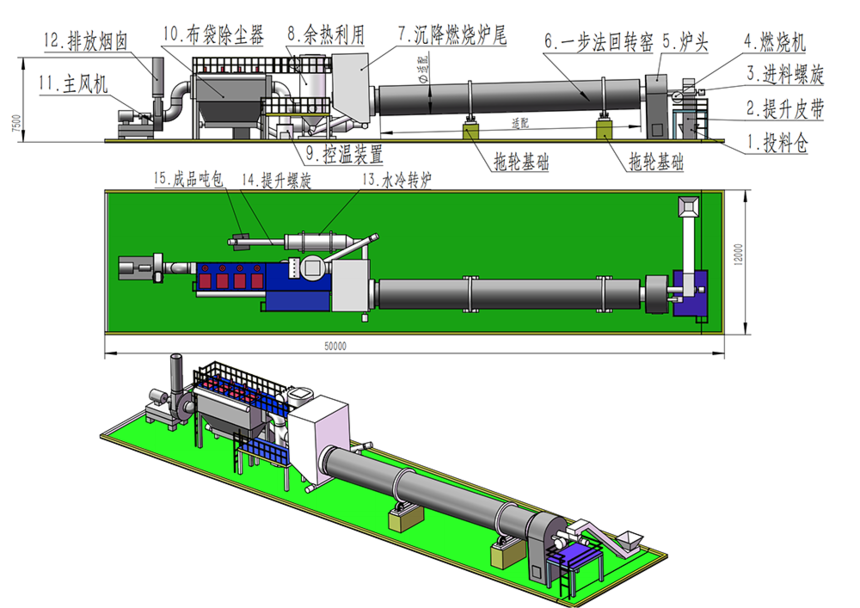
Agricultural and forestry residues such as sawdust, coconut fibre, palm fibre, wood chips and bagasse are attractive activated-carbon feedstocks because they are often available locally and in volume. The challenge is that these materials arrive wet, light and variable, so a conventional route with separate drying, carbonization and activation stages can add handling steps, energy use and floor space. This note explains what a one-step line changes and what buyers should confirm before asking for a quotation, using only the figures Guanbaolin (GBL Carbon) already publishes for its One-Step Carbonization and Activation System for Biomass.
What "one-step" means in practice
In a conventional activated-carbon plant, raw material is dried, carbonized into char, and then activated with steam in a separate kiln. A one-step system integrates these stages, so the need for separate drying and carbonization stages is reduced. Recovered heat can be used for hot water, drying or steam generation on site.
The same system can also be configured for drying and regeneration of spent powdered or granular activated carbon, which matters for producers who want one line to handle both new production and returned carbon.
Published reference figures
| Item | Figure published by Guanbaolin |
|---|---|
| Suitable feedstocks | Sawdust, coconut fibre or shell, palm fibre, wood chips, bagasse, spent powdered carbon |
| Output | 2–10 t/day of activated carbon |
| Feed capacity | 20–200 t/day |
| Typical coconut-fibre feed ratio | About 11 t of feed per 1 t of activated carbon (wet-basis yield 10:1 or 11:1) |
| Product indicators | Iodine number 950–1100 mg/g; methylene blue >10–12 mL/0.1 g |
| Production cost target | ≤ CNY 1,300/t |
| Site | Factory height ≥ 8 m; about 500 m² floor area |
| Electricity demand | 70–100 kW |
These are reference figures for the standard system. Actual yield, quality and cost depend on the specific feedstock, its moisture and ash, and site conditions, and are confirmed during technical review.
Five things to check before comparing lines
1. Feedstock moisture and consistency. A wet-basis ratio of 10:1 or 11:1 means feed tonnage is roughly ten times product tonnage. Confirm how much feed you can supply every day, how wet it is, and whether it changes by season. Feed logistics often decide plant size more than the kiln does.
2. Ash content of the raw material. Ash does not burn off during activation, so it concentrates in the product. High-ash residues can limit the grades you can sell even when iodine number looks acceptable.
3. Target market for the carbon. Iodine and methylene-blue values indicate adsorption capacity, but water treatment, air purification and other buyers each set their own particle size, hardness and impurity limits. Decide which market you are producing for before fixing the target specification.
4. Site space and utilities. Check that the building can provide at least 8 m of height and about 500 m² of floor area, and that the electrical supply covers the stated demand. Also decide how recovered heat will be used, since that affects the overall energy balance.
5. Whether you also need regeneration. If you or your customers generate spent powdered or granular carbon, ask about the drying and regeneration option at the same time rather than planning a second line later.
What to send for a technical review
To get a focused answer, send:
Feedstock type, moisture and, if available, ash and a sample
Planned output (t/day) or available feed (t/day)
Target product specification and market
Site utilities, available building space and destination country
Guanbaolin's team will review suitability, scope of supply and the next technical questions before a commercial quotation. You can also compare this system with our rotary-kiln activation system for coal, shell and other carbonized feedstocks.
Request a Technical Review or email Vincentlee@gblcarbon.com.
Previous: None
Next: None