
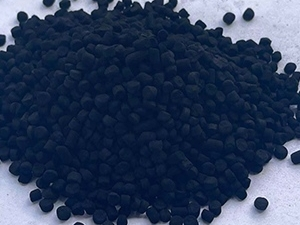
Coconut Shell Granular Activated Carbon
Guanbaolin's coconut shell granular activated carbon is a native granular carbon made from coconut-shell char, steam activated, acid-washed and screened into sizes from 5–10 to 60–100 mesh. Published values are an iodine number of 1100–1150 mg/g, CTC of 82–95% and ash of ≤3%. It is used for gas-phase VOC treatment, solvent recovery and liquid-phase water treatment.
The granules are native coconut-shell carbon: they come from the coconut shell itself, not from char powder formed into pellets. Production includes steam activation, acid washing, water washing, drying and screening into five mesh ranges.
What Is Coconut Shell Granular Activated Carbon?
Coconut shell granular activated carbon is an adsorbent made from coconut-shell raw material and supplied as granules rather than powder or cylindrical pellets. Buyers meet more than one product under similar names, and it is worth knowing which one you are being quoted:
| Product type | How the carbon is formed | This page |
|---|---|---|
| Native crushed coconut-shell carbon | The shell itself is carbonized, activated and crushed into granules | Yes |
| Pelletized (cylindrical) carbon | Carbon powder is formed into whole cylindrical pellets | No — see our pelletized activated carbon |
Our coconut shell activated carbon granules belong to the first group: native coconut-shell granules, screened into five mesh ranges.
How are native coconut-shell activated carbon granules produced?
Coconut-shell granular activated carbon is made from coconut-shell char as native shell granules, rather than carbon powder formed into pellets. Published production steps include steam activation, acid washing, water washing, drying and screening. The granules are screened into five mesh ranges, from 5–10 to 60–100 mesh.
The production steps below are the ones published for this product. We do not publish process temperatures, residence times or the detailed process sequence on this page; they are confirmed on inquiry where relevant to your project.
Acid and water washing is part of the published process for this grade; the acid used and any residual values are confirmed on inquiry.
Coconut Shell Activated Carbon Specification
| Field | Value |
|---|---|
| Raw material | Coconut-shell char |
| Form | Native coconut-shell granules |
| Activation / post-treatment | Steam activated; acid-washed, water-washed, dried |
| Particle size | 5–10, 10–24, 24–40, 40–60, 60–100 mesh |
| Iodine number | 1100–1150 mg/g |
| CTC | 82–95% |
| Ash | ≤3% |
| Hardness / mechanical strength | Confirmed on inquiry |
| Bulk / apparent density | Confirmed on inquiry |
| Moisture | Confirmed on inquiry |
| pH | Confirmed on inquiry |
| Surface area | Confirmed on inquiry |
| Packaging | Confirmed on inquiry |
| MOQ | Confirmed on inquiry |
| Test standard | Confirmed on inquiry |
A certificate of analysis (COA) can be requested for your order; the documents supplied with each batch and the test standard are confirmed on inquiry. Agree before ordering whether each value is a typical figure or a guaranteed limit. For a buyer's checklist, read how to verify coconut shell carbon specifications.
Request a sample and COA for your application — tell us the application, target contaminant, flow or quantity, required mesh and destination port.
Mesh Sizes and Typical Uses
Mesh size controls two things that pull in opposite directions: how fast the carbon adsorbs and how much resistance the bed creates. As a general rule, finer granules give faster adsorption but a higher pressure drop, while coarser granules keep bed resistance low and suit higher flow rates.
| Mesh range | General character | Recommended application |
|---|---|---|
| 5–10 mesh | Coarsest range; lowest bed resistance | Confirmed on inquiry |
| 10–24 mesh | Coarse to medium | Confirmed on inquiry |
| 24–40 mesh | Medium | Confirmed on inquiry |
| 40–60 mesh | Fine | Confirmed on inquiry |
| 60–100 mesh | Finest range; fastest contact, highest pressure drop | Confirmed on inquiry |
Choose the range that matches your adsorber design, gas or water flow and allowable pressure drop. Send these with your inquiry and we will confirm the recommended range.
Applications
What is coconut shell activated carbon used for? For this grade, the published applications are gas-phase and liquid-phase treatment.
Gas-Phase VOC Treatment and Solvent Recovery
In vapour-phase adsorbers, the carbon captures volatile organic compounds from exhaust air or process gas, and in solvent recovery units it holds the solvent until it is desorbed. CTC (carbon tetrachloride activity) is the usual indicator of vapour-phase adsorption capacity, and this grade is published at a CTC of 82–95%. In high-airflow systems, choose the mesh range with your allowable pressure drop in mind (see the mesh table above).
Liquid-Phase Water Treatment
In liquid-phase filters and contactors, the granules adsorb dissolved organics from water. Selection depends on the contaminant, contact time and the treatment target, so a pilot or laboratory test is the safest way to confirm the grade before a bulk order.
Other applications not listed here are confirmed on inquiry.
Coconut Shell vs Coal Based Granular Activated Carbon
Coconut shell vs coal activated carbon is a common choice for buyers. The comparison below is qualitative; we do not publish side-by-side figures for the two products.
| Aspect | Coconut-shell GAC (this page) | Coal-based GAC |
|---|---|---|
| Raw material | Coconut-shell char (native granules) | Anthracite |
| Pore structure tendency | Iodine number and CTC are the published adsorption indicators; pore-size distribution confirmed on inquiry | Predominantly microporous; see the coal-based GAC page for its pore description |
| Typical published uses | VOC treatment, solvent recovery, liquid-phase water treatment | Municipal drinking water, organic-gas purification |
For the anthracite product, see our coal based granular activated carbon. For every carbon type we supply, see our overview as a granular activated carbon manufacturer.
Regeneration and Pilot Testing
This grade is described as having good regenerability, so spent carbon does not have to be treated as a one-way consumable.
Test → Supply → Regenerate. Before you scale up, we can test the carbon on your stream through our pilot testing and process design service, run in pilot laboratories of approximately 500 m². We then supply the selected grade. When the carbon is spent, it can be sent for thermal regeneration — see our activated carbon regeneration service, backed by a published capacity of 15,000 t/year at our Xinjiang base — or regenerated on site in a GAC regeneration furnace of 5–50 t/day.
Recovery after regeneration and the number of cycles depend on the adsorbed load and are confirmed on inquiry.
Packaging, MOQ and Export
As a coconut shell activated carbon supplier, we confirm packaging, MOQ, lead time and country of origin for each order. Samples are available; the buyer pays the courier cost. Answers to common questions on MOQ, samples and export packing are in our FAQ.
Guanbaolin also operates a Philippine coconut-shell production base. The production origin of this specific grade is confirmed on inquiry.
| Item | Value |
|---|---|
| Packaging | Confirmed on inquiry |
| MOQ | Confirmed on inquiry |
| Lead time | Confirmed on inquiry |
| Origin of this grade | Confirmed on inquiry |
FAQ
What is coconut shell activated carbon used for?
This grade is published for gas-phase VOC treatment, solvent recovery and liquid-phase water treatment. Other applications are confirmed on inquiry; send your target contaminant and flow for a technical review.
Coconut shell vs coal activated carbon: which should I choose?
It depends on the contaminant, the phase (gas or liquid) and your operating conditions. Our coconut shell granular activated carbon is published for VOC, solvent recovery and water treatment; our coal based granular activated carbon is published for municipal drinking water and organic-gas purification. A pilot test is the reliable way to decide.
What does CTC mean in activated carbon?
CTC is the carbon tetrachloride activity: the share of its own weight that a carbon adsorbs when exposed to carbon tetrachloride vapour under standard test conditions. It is used as an indicator of vapour-phase adsorption capacity. This grade is published at a CTC of 82–95%.
Which mesh size should I choose?
Finer mesh adsorbs faster but raises pressure drop; coarser mesh keeps bed resistance low. Match the range to your adsorber, flow and allowable pressure drop. This grade is offered in 5–10, 10–24, 24–40, 40–60 and 60–100 mesh; the recommended range for your application is confirmed on inquiry.
Can coconut shell granular activated carbon be regenerated?
Yes. This grade is described as having good regenerability, and spent carbon can be thermally regenerated. Recovery and cycle numbers depend on the adsorbed load and are confirmed on inquiry. See our activated carbon regeneration service.
Request a Technical Review
What should buyers check when comparing coconut carbon for a filter?
For a coconut carbon filter comparison, identify the treatment phase and operating conditions before choosing the media. This coconut-shell granular grade is published for VOC treatment, solvent recovery and liquid-phase water treatment. Match the mesh range to adsorber design, flow and allowable pressure drop; confirm liquid-phase suitability through a pilot or laboratory test before a bulk order.
Tell us your application, target contaminant, flow or quantity, required mesh and destination port, and we will confirm the matching grade, sample and COA. Request a sample and COA for your application or call +86 13355329772.