
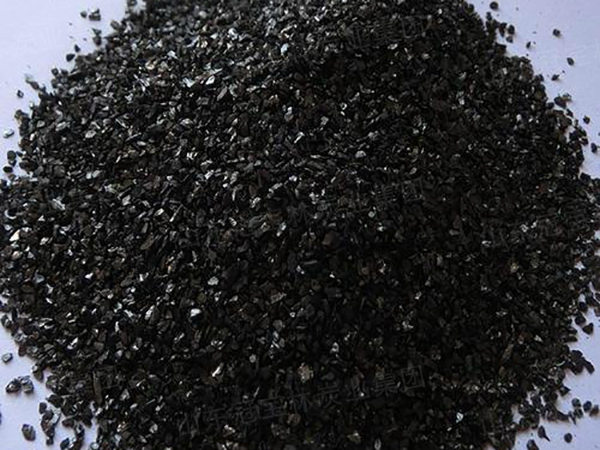
Coal Based Granular Activated Carbon
Guanbaolin's coal based granular activated carbon is made from anthracite and steam-activated in an internally heated rotary kiln. It has a predominantly microporous structure and is used for advanced purification of municipal drinking water and for organic-gas purification. Mesh size, iodine number and other specifications are confirmed on inquiry for each project.
Send your target specification for a matching coal-based grade
What is coal-based granular activated carbon and how is it activated?
Coal-based granular activated carbon is supplied as black, irregular granules made from anthracite. It is steam-activated in an internally heated rotary kiln. The granules are used in fixed beds, including filters, contactors and adsorbers, through which water or gas passes.
Coal based activated carbon is widely used in water treatment, where hard granules matter because the bed is backwashed and handled repeatedly. Buyers often compare it with coconut-shell carbon; see the note after the filter-media comparison below.
Raw Material and Activation Process
The published process for this product has three elements:
- Feedstock: anthracite. This is an anthracite coal activated carbon.
- Kiln: internally heated rotary kiln. The carbon is activated continuously in a rotating, inclined kiln heated from the inside.
- Activation: high-temperature steam. Steam reacts with the carbonized anthracite to open and develop the pore structure. No chemical activation step is listed.
Guanbaolin also designs and supplies rotary-kiln activation equipment — see our rotary-kiln activation system — so questions about how your grade is activated can be answered by the team that builds the kilns. Activation temperatures, residence times and yields are not published and are confirmed on inquiry.
Pore Structure and Performance
The product is described with a predominantly microporous structure, with mesopores and macropores as secondary pores. In practice this means:
- Micropores provide most of the adsorption surface and suit small organic molecules, taste and odour compounds and many vapour-phase contaminants.
- Mesopores and macropores act as transport pores that let molecules reach the micropores more quickly.
The published performance characteristics are developed porosity, large surface area, strong adsorption, high mechanical strength, low bed resistance, chemical stability and regenerability. We do not attach numbers to these characteristics on this page; the values that matter for your design are confirmed with a COA for the grade we propose.
Technical Specifications
| Field | Value |
|---|---|
| Raw material | Anthracite |
| Form | Black irregular granules |
| Activation | Steam, internally heated rotary kiln |
| Pore structure | Predominantly microporous (mesopores and macropores secondary) |
| Particle size (US mesh) | Confirmed on inquiry |
| Iodine number | Confirmed on inquiry |
| Methylene blue | Confirmed on inquiry |
| CTC | Confirmed on inquiry |
| Hardness / abrasion | Confirmed on inquiry |
| Ash | Confirmed on inquiry |
| Moisture | Confirmed on inquiry |
| Apparent density | Confirmed on inquiry |
| pH | Confirmed on inquiry |
| Packaging | Confirmed on inquiry |
| MOQ | Confirmed on inquiry |
| Test standard | Confirmed on inquiry |
A COA can be requested for your order; send your target specification for a matching grade.
Request a Technical Review — include the application, target contaminant, flow or quantity, required mesh and destination port.
Applications
Municipal Drinking Water Purification
The product is published for advanced purification of municipal drinking water, typically as a GAC filter or post-filter contactor after conventional treatment. Guanbaolin holds a water-contact approval for coal-based activated carbon; the scope and approval number are confirmed on inquiry. Because water quality differs from plant to plant, the grade, mesh and bed design should be confirmed against your raw-water data or a pilot test.
Organic Gas Purification
In vapour-phase adsorbers, the granules capture organic compounds from exhaust or process gas. Low bed resistance is important in this service because it keeps fan energy and pressure drop under control at high airflow. For the CTC or other vapour-phase indicator of the grade we propose, ask for the COA.
Other applications are confirmed on inquiry.
How to Select Coal Based GAC
Selection is a method, not a single number. Work through this checklist and send the answers with your inquiry:
- Target contaminant. What must be removed, at what inlet concentration, and to what outlet limit? This decides the pore structure you need.
- Flow and empty-bed contact time (EBCT). Flow rate and bed volume together set the contact time; more contact time generally means better removal and longer bed life.
- Mesh vs pressure drop. Finer granules adsorb faster but increase pressure drop; coarser granules keep resistance low. Match the mesh to the filter's hydraulic design.
- Hardness for backwash. If the bed is backwashed or transferred hydraulically, carbon hardness and abrasion resistance determine how much is lost as fines.
- Regeneration plan. Decide early whether spent carbon will be replaced or regenerated, because harder carbon generally tolerates more regeneration cycles.
Our recommended values for each step are confirmed on inquiry.
Coal Based GAC vs Anthracite Filter Media
Buyers often search "anthracite vs granular activated carbon". Both start from anthracite, but they are different materials doing different jobs:
| Aspect | Coal based GAC (this page) | Anthracite filter media |
|---|---|---|
| What it is | Activated carbon (adsorbent) | Non-activated filter medium |
| Raw material | Anthracite, steam activated | Anthracite |
| How it works | Adsorbs dissolved or vapour contaminants in its pores | Physically filters suspended solids |
| Published uses | Drinking water, organic-gas purification | Dual-media and multimedia filtration |
| Product page | — | anthracite filter media |
In short: anthracite filter media removes particles; activated carbon removes dissolved and vapour contaminants. Many water plants use both in different layers or stages.
If you are choosing between coal-based and coconut-shell carbon, see the comparison on our coconut shell granular activated carbon page.
Regeneration of Spent Coal Based GAC
The product is described as regenerable. Granular activated carbon regeneration removes adsorbed contaminants by heat and steam so the carbon can return to service, with make-up carbon added for losses.
Test → Supply → Regenerate. Before you scale up, we can test candidate grades on your water or gas through our pilot testing and process design service, using pilot laboratories of approximately 500 m². We then supply the selected grade. When the carbon is spent, send it for spent GAC regeneration — our Xinjiang base publishes a capacity of 15,000 t/year — or regenerate it on site with our granular activated carbon regeneration system, rated at 5–50 t/day.
Recovery after regeneration and the number of cycles depend on the adsorbed load and are confirmed on inquiry.
FAQ
What is the difference between anthracite filter media and coal based activated carbon?
Anthracite filter media is a hard, non-activated coal used to filter out suspended solids. Coal based activated carbon has been steam-activated to create an internal pore structure, so it adsorbs dissolved and vapour contaminants. Our coal based GAC is made from anthracite but is an adsorbent, not a filter medium.
Is your coal based GAC suitable for drinking water treatment?
Yes. It is published for advanced purification of municipal drinking water, and Guanbaolin holds a water-contact approval for coal-based activated carbon; its scope and number are confirmed on inquiry. The grade and mesh for your plant should be confirmed with raw-water data or a pilot test.
What iodine number does your coal based GAC have?
The iodine number for this coal-based grade is confirmed on inquiry and stated on the COA for the grade we propose. The iodine number indicates micropore adsorption capacity under standard test conditions and is only comparable between carbons tested by the same method.
How long does coal based GAC last in a filter?
It depends on the inlet load, flow rate and empty-bed contact time. Service life is set by breakthrough monitoring: the carbon is replaced or regenerated when the outlet concentration approaches your limit.
Can coal based GAC be regenerated?
Yes. The product is described as regenerable, and spent coal based GAC can be thermally regenerated and reused. See our spent GAC regeneration page for the service and equipment options.
Does coal based GAC need backwashing?
Water-treatment GAC beds are usually backwashed to remove trapped solids, relieve pressure drop and re-classify the bed. Backwash rate and frequency depend on the filter design and the carbon's mesh and density; our recommended parameters for this grade are confirmed on inquiry.
Request a Technical Review
What needs confirmation before ordering coal-based GAC for a water filter?
For a water-filter inquiry, identify the required coal-based granular grade rather than relying on a generic activated-charcoal search term. Guanbaolin lists anthracite-based, steam-activated GAC for municipal drinking-water purification. Confirm the grade, mesh and bed design against raw-water data or a pilot test, and request the proposed grade’s COA because its specification values are confirmed on inquiry.
Send your target specification for a matching coal-based grade: application, target contaminant, flow or quantity, required mesh and destination port. Answers on MOQ, samples and packing are in our FAQ. To compare all carbon types, see our page as a granular activated carbon supplier in China. Phone: +86 13355329772.