
Honeycomb Activated Carbon for VOC Exhaust: What to Confirm Before You Order
When honeycomb activated carbon suits VOC exhaust, how it compares with granular carbon, and what airflow, humidity and solvent data to send before ordering.
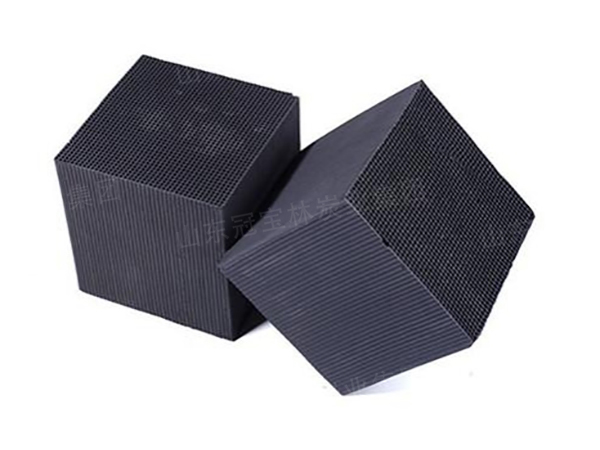
Most inquiries we get for honeycomb activated carbon start with one line: "How many blocks do I need?" It's a fair question, but we can't answer it from the box size alone. The number of blocks follows from the exhaust itself: how much air, which solvents, how wet, how hot, how dusty.
This article walks through what we check before quoting honeycomb carbon for VOC and odour duties, and where granular carbon is the better buy.
What is honeycomb activated carbon used for?
Honeycomb activated carbon is for low-concentration, high-air-volume organic exhaust and odour. It's a carbon block with straight square channels, so air passes through with low resistance.
On our Honeycomb Activated Carbon for VOC Treatment page, the listed organic gases are toluene, xylene, phenols, esters and alcohols. Typical places are spray booths, printing and coating lines, chemical workshops, food plants with odour complaints, and general ventilation exhaust.
The key word is low concentration. Honeycomb carbon is usually the polishing stage in an adsorption box, or the adsorption bed ahead of desorption and catalytic oxidation. If the stream is rich in solvent, a single pass through blocks will load them very quickly, and you'll be changing carbon far more often than you budgeted for.
Honeycomb or granular activated carbon: which one fits your exhaust?
Choose honeycomb when airflow is large and fan pressure is limited. Choose granular or pelletized carbon when you need more carbon mass in a given volume and can accept a higher pressure drop.
Here is how we usually explain the trade-off to buyers:
| Point of comparison | Honeycomb activated carbon | Granular / pelletized carbon |
|---|---|---|
| Airflow resistance | Low, straight channels | Higher, air passes through a packed bed |
| Carbon mass per box volume | Lower | Higher |
| Best fit | Large air volume, low VOC concentration, odour | Smaller air volume or higher loading per volume |
| Dust tolerance | Channels can block; needs good pre-filtration | Also needs pre-filtration; fines raise pressure drop |
| Handling | Stacked blocks, quick to change | Bulk fill or drums, needs a filling and emptying method |
| Desorption systems | Common in adsorption + desorption + catalytic oxidation units | Used in fixed beds and solvent recovery |
If you're already running a granular bed and the fan can't keep up, honeycomb may solve it. If your box is small and the concentration is high, honeycomb on its own rarely does. We also supply pelletized activated carbon for gas treatment, so we don't have a reason to push one over the other.
What exhaust data should you send before asking for a quote?
Send the air volume, the solvent list with concentrations, temperature, humidity and dust load. Without those five, any quote is a guess.
Air volume in m³/h, at normal operation and at peak.
VOC composition and concentration. A solvent list from the paint or ink supplier's SDS is a good start; an inlet measurement is better.
Temperature at the carbon box. Adsorption capacity falls as temperature rises.
Relative humidity. Water vapour competes with VOCs for pore space. Wet exhaust from washing, curing or food processing needs drying or cooling ahead of the carbon.
Dust, paint mist or oil mist. These coat the channel walls. Ask the box supplier what pre-filter stages are fitted.
Outlet requirement. Name the local emission limit or the odour target you have to meet.
Box dimensions and the current block layout, if you're replacing carbon in an existing unit.
You'll find a short explanation of how adsorption capacity is used up in Activated Carbon Air Filter Working Principle.
Which honeycomb carbon specifications should go into the order?
Put the block dimensions, the activity figure your duty depends on, and the moisture limit into the purchase order as limits, not typical values.
Our product page quotes an adsorption rate of up to 90%. Treat a figure like that as a product claim under test conditions, not as the efficiency of your box. Real performance depends on contact time, inlet concentration and the condition of the pre-filters.
For the block itself, confirm:
Block size and cell density. Blocks need to fit your frames without gaps. Air always takes the easy path, and a gap between blocks lets untreated air straight through.
Activity for gas-phase use. Ask which test the supplier reports, for example iodine value, CTC or benzene adsorption, and the method used. Iodine value is a liquid-phase test and doesn't tell the whole story for vapour.
Strength. Blocks get stacked, shipped and handled. Ask how breakage is checked.
Moisture at delivery. Honeycomb carbon picks up water in storage. Keep it sealed until installation.
Our guide How to Read an Activated Carbon Spec Sheet (COA) Before You Order explains typical versus guaranteed values in more detail.
How do you know when honeycomb carbon needs changing?
Change or regenerate it when the outlet reading or the odour check shows breakthrough. A calendar date on its own isn't a reliable trigger.
Ask whoever runs the system to define how the outlet is monitored, whether by a portable VOC meter, a fixed analyser or a third-party test. Keep those readings with the production record. When solvent use goes up during a busy month, the carbon loads faster, and the records show that.
One safety point. Some solvents, ketones in particular, release noticeable heat when adsorbed. In a box with poor airflow or high loading, that heat can build up. Your system designer should confirm temperature monitoring and the fire protection for the box.
Can spent honeycomb carbon be regenerated?
Sometimes, and it depends on the system. In adsorption–desorption units, hot air desorbs the VOCs in place and the blocks stay in service for a long time. Blocks from a simple adsorption box usually go for replacement and disposal under local hazardous waste rules.
If your site uses a large amount of spent granular or powdered carbon, off-site reactivation may be worth a look. See our spent activated carbon regeneration services and Spent Activated Carbon: Regeneration Service or On-Site Equipment?
Send us your exhaust data
If you send the airflow, solvent list, temperature, humidity and box drawing, we'll review whether honeycomb carbon fits and what grade and quantity make sense. Contact us through the contact page or at Vincentlee@gblcarbon.com.
FAQ
Is honeycomb activated carbon better than granular carbon for VOC removal?
Not in every case. Honeycomb is better when air volume is high and fan pressure is limited. Granular or pelletized carbon holds more carbon in the same volume, which suits smaller airflows or heavier loading.
Which VOCs can honeycomb activated carbon treat?
Our product information lists toluene, xylene, phenols, esters and alcohols, plus odorous and ventilation exhaust. Very light or highly volatile compounds adsorb poorly on carbon and should be checked case by case.
Why does high humidity reduce honeycomb carbon performance?
Water vapour takes up pore space that would otherwise hold VOCs. Wet exhaust should be cooled, dried or demisted before it reaches the carbon.
How should honeycomb carbon be stored before installation?
Keep it sealed, dry and away from solvent vapour. Open packaging adsorbs moisture and odours from the warehouse, which uses up capacity before the blocks are installed.
What information do you need to quote honeycomb activated carbon?
Airflow, VOC list and concentration, temperature, humidity, dust load, outlet requirement, block size and the quantity or box layout.
Previous: None
Next: None