
Spent Activated Carbon: Regeneration Service or On-Site Equipment?
Decide between sending spent activated carbon to a regeneration service and installing an on-site furnace by reviewing daily volume, location, adsorbed load, utilities and off-gas treatment. Use Guanbaolin’s published capacities as a planning baseline.
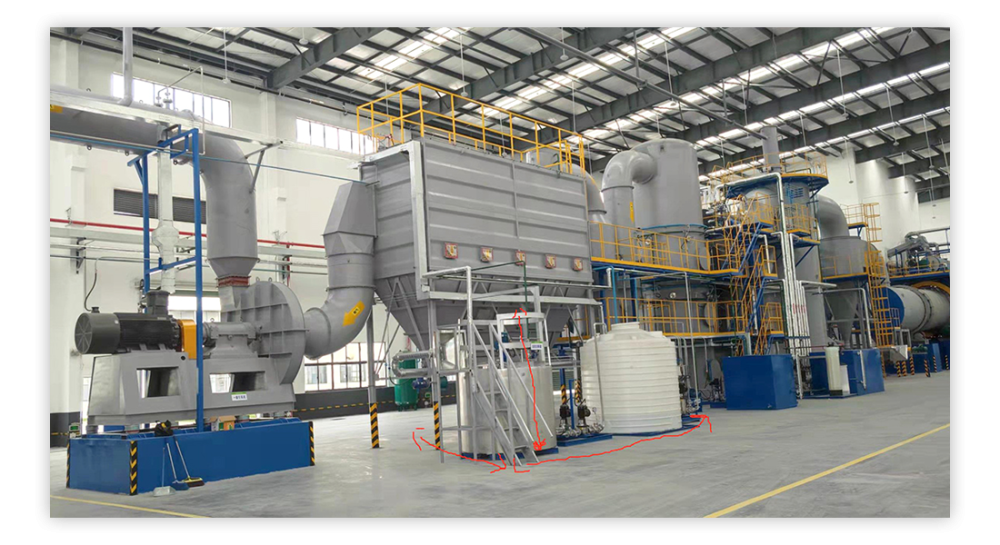
Spent activated carbon regeneration restores pore volume so the carbon can return to service instead of being disposed and replaced. At industrial scale this is usually a thermal, rotary-kiln route: drying, desorption and pyrolysis of adsorbed substances, then steam reactivation, followed by cooling and discharge. The off-gas must be treated because it carries the contaminants released from the carbon.
Guanbaolin approaches regeneration from both sides. We operate a spent-carbon regeneration service at our Xinjiang base, and we manufacture regeneration equipment for plants that regenerate on site. The choice between service and equipment should follow the plant’s volume, location and utilities—not a single cost headline.
What the thermal route involves
Thermal regeneration uses heat and a controlled atmosphere to remove adsorbed substances from spent carbon. A rotary kiln tumbles the bed through a heated drum so particles see heat and steam more evenly. Integrated exhaust treatment is part of a complete scope, because the off-gas carries the released contaminants.
Chemical or solvent washing methods exist for specific cases, but thermal regeneration is the usual industrial route for granular carbon.
When a regeneration service is the practical route
Guanbaolin’s spent activated carbon regeneration service covers recovery, processing, reuse and regeneration support for industrial environmental-treatment projects. The service is operated by Xinjiang Guanbaolin Renewable Energy Co., Ltd. in Tiemenguan, Xinjiang. The base publishes an annual handling and regeneration capacity of 15,000 tonnes and runs rotary-kiln systems for activation and regeneration.
A service review typically follows three steps: condition review → regeneration route → service support. You provide the carbon type, adsorbed substances, quantity and current handling method. Acceptance is decided case by case after that review, rather than by a universal acceptance list. Turnaround depends on quantity, location and logistics and is confirmed on inquiry.
For plants outside China, logistics often make on-site regeneration equipment the more practical route. Contact us to discuss which path fits your location and volume.
When on-site equipment is the better fit
Plants with a steady daily spent-carbon stream, local utilities and an emission-treatment plan may prefer to regenerate on site. Guanbaolin manufactures regeneration systems for granular carbon, powdered carbon and activated coke. Published capacities from our product pages:
| System | Published capacity | Published notes |
|---|---|---|
| GAC regeneration system | 5–50 t/day | Dry-basis yield ≥90%, excluding adsorbed impurities; controlled steam input |
| PAC regeneration system | 5–30 t/day | Yield ≥30% for material at 50% moisture; internal- and external-heating variants; PLC control |
| Activated coke regeneration system | 5–20 t/day | Online regeneration for activated-coke adsorption beds, with steam secondary activation |
| One-step carbonization and activation system | Output 2–10 t/day | Includes drying and regeneration options for spent powdered or granular carbon |
| Rotary dryer | 0.5–50 t/h per unit | Pre-drying of wet activated carbon; feed moisture 20%–70% |
Sizing starts with tonnes of spent carbon per day, moisture and adsorbed load. Spent-carbon regeneration trials can be run before full-scale design in pilot laboratories of approximately 500 m². Equipment lead time and price are confirmed on inquiry for each project.
Whether a standard activation or carbonization kiln configuration can be adapted for your spent carbon is also confirmed on inquiry, based on carbon type, adsorbed load and off-gas treatment.
Regeneration versus replacement
Regeneration cost is quoted per project because it depends on volume, energy price, logistics and contamination. As a general comparison, regeneration avoids buying a full volume of new carbon and reduces spent-carbon disposal, while replacement avoids furnace investment or service fees. Larger, steady volumes usually favour regeneration.
Well-controlled reactivation restores much of the original adsorption capacity, but each cycle loses some carbon to burn-off and attrition, so make-up carbon is added. The published dry-basis yield of ≥90% for our GAC system is a planning benchmark for that loss; iodine recovery after regeneration is confirmed on inquiry. How many times a grade can be regenerated depends mainly on hardness and contaminant load.
Applications that commonly regenerate
Water treatment — waterworks, wastewater plants and related facilities that regenerate hazardous-waste activated carbon rather than replace every change-out.
Gold CIP/CIL — carbon is generally eluted and then thermally reactivated before it returns to the circuit.
Food and sugar decolourisation — when the organic load allows thermal regeneration; suitability is confirmed for the specific process.
Waste gas / VOC beds — including activated coke beds regenerated online or off site.
Decision checklist before you inquire
Daily or weekly spent-carbon tonnage and moisture.
Carbon form (GAC, PAC or activated coke) and adsorbed substances.
Plant location and whether cross-border logistics are involved.
Available utilities (fuel or power, steam, water) and off-gas treatment expectations.
Whether you need a one-time campaign, a recurring service, or a permanent on-site furnace.
Whether a pilot regeneration trial is required before committing to equipment or a long-term service contract.
Frequently asked questions
Do you offer a regeneration service or only equipment?
Both. We supply regeneration equipment and run spent-carbon regeneration services through our Xinjiang base (published 15,000 t/year capacity). For plants outside China, on-site equipment is usually the practical route.
Can spent activated carbon be regenerated in a rotary kiln?
Yes. Thermal regeneration commonly uses a rotary kiln. Our Xinjiang base runs rotary-kiln regeneration systems. On-site, size the furnace from your daily volume; our published GAC regeneration range is 5–50 t/day. Suitability of a given configuration is confirmed on inquiry.
How much carbon is lost in regeneration?
Our GAC regeneration system has a published dry-basis yield of ≥90%, excluding adsorbed impurities. The powdered system’s published yield is ≥30% for material at 50% moisture.
Start a regeneration review
Send the carbon type, adsorbed substances, tonnes per day, moisture, site utilities and location to Vincentlee@gblcarbon.com or WhatsApp +86 133 5532 9772. Website: https://www.gblcarbon.com/
Related pages: Activated Carbon Regeneration · Activated Carbon Rotary Kiln
Previous: None
Next: None