
Activated Carbon Filter Pressure Drop: Does It Mean the Carbon Is Exhausted?
A rising pressure drop across a granular activated carbon water filter does not, on its own, establish that the carbon's adsorption capacity is exhausted. Pressure drop describes resistance to flow. Treatment performance must be assessed against the target contaminants and the required outlet qu
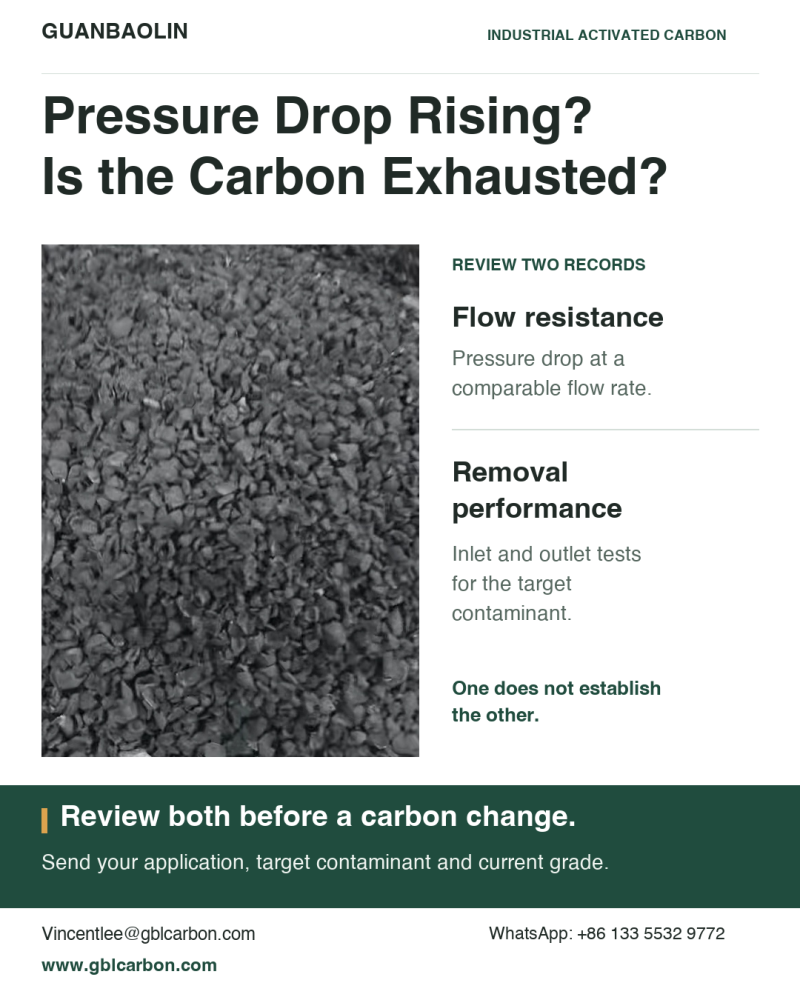
A rising pressure drop across a granular activated carbon water filter does not, on its own, establish that the carbon's adsorption capacity is exhausted. Pressure drop describes resistance to flow. Treatment performance must be assessed against the target contaminants and the required outlet quality.
For plant operators and purchasing teams, separating these two questions helps define the problem before ordering replacement carbon. Review the operating records with the site's technical team and follow the equipment's specified procedures.
What Pressure Drop Can Tell You
Pressure drop is the pressure difference measured across a defined part of the system. Its meaning depends on the measurement points, flow rate, water temperature and equipment condition.
An increase may be associated with accumulated suspended solids, fines, biological growth or changes in the bed and flow conditions. Restrictions in other components may also affect the reading, depending on where the pressure is measured.
Compare readings at a similar flow rate and review the change against the system's baseline. A pressure increase calls for investigation under the site's operating procedures; it is not a direct measurement of remaining adsorption capacity.
How to Assess Contaminant Breakthrough
Breakthrough describes a target substance appearing in the filter outlet as removal performance changes. The relevant action point depends on the required outlet quality and the monitoring plan established for that application.
Use suitable inlet and outlet measurements for the target contaminant. Record sampling locations, methods and operating conditions so results can be interpreted consistently. Inlet concentration changes, flow changes or other process disturbances can also affect outlet results and need review.
Adsorption breakthrough can occur without a significant rise in pressure drop. Conversely, a bed can develop hydraulic resistance while still retaining some capacity for the substance being monitored. Pressure readings and contaminant measurements serve different purposes.
What Backwashing Can and Cannot Do
Where a filter is designed for backwashing, the procedure may remove accumulated solids and improve hydraulic conditions. Use the flow, expansion and operating requirements specified for the actual equipment and media.
Backwashing does not thermally reactivate the carbon or regenerate adsorption capacity consumed by adsorbed contaminants. An improved pressure reading after backwashing is not proof that the original adsorption performance has returned.
Three Records to Review Before a Carbon Change
Treatment results
Review inlet and outlet data for the target contaminants against the site's action limits. Include relevant process changes and any established sampling requirements.
Hydraulic and maintenance history
Review pressure drop at comparable flow rates, backwashing where applicable, and maintenance or inspection records. Confirm that the measurements refer to the intended part of the system.
Carbon and operating history
Record the installed grade, loading date, approximate treated volume, flow range and changes to inlet loading. Include the reason for the proposed replacement, whether performance, hydraulic condition, a site requirement or a planned shutdown.
Define Replacement Criteria for the Actual Application
There is no single replacement interval established by carbon appearance or pressure drop alone. A routine schedule may form part of a site's operating plan, but it should be reviewed against applicable requirements, treatment results and operating experience.
The plant's technical team should define monitoring frequency, action limits and the response to an abnormal result. When a different carbon grade is proposed, review the specification and relevant application testing before making service-life assumptions.
Information to Send with a Replacement Enquiry
Provide the application, target contaminants, required outlet result, current carbon specification, relevant operating records, required quantity or designed bed volume, packaging requirements and delivery destination. Mark unknown details for follow-up rather than estimating them from product appearance.
We supply activated carbon production equipment and finished activated carbon. Share your replacement requirement so we can review the material specification and available information with the factory.
Email: Vincentlee@gblcarbon.com
WhatsApp: +86 133 5532 9772
Website: https://www.gblcarbon.com/
Previous: None
Next: None