
Activated Carbon Production Equipment: How to Compare Energy Consumption per Tonne
An energy figure can look attractive in an equipment quotation while leaving important questions unanswered. Does it cover the furnace alone or the whole production line? Is it based on raw material input or finished activated carbon output? Was it measured during operation or calculated during desi
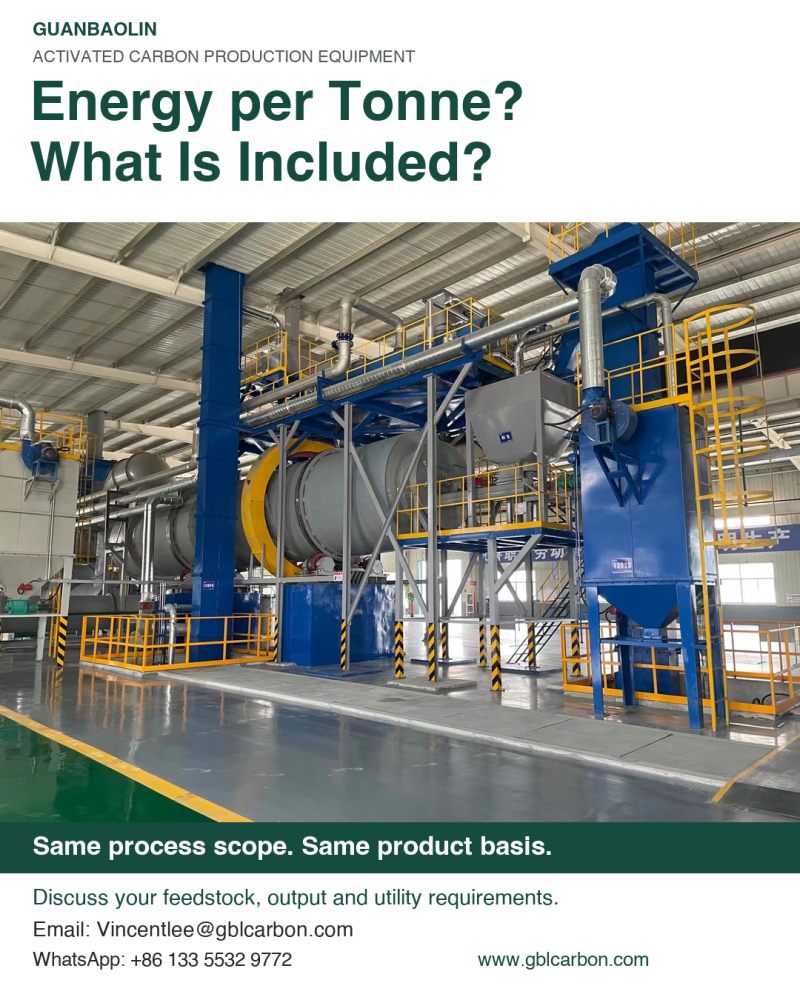
An energy figure can look attractive in an equipment quotation while leaving important questions unanswered. Does it cover the furnace alone or the whole production line? Is it based on raw material input or finished activated carbon output? Was it measured during operation or calculated during design?
When comparing activated carbon production equipment, buyers need these details alongside the number. A lower figure does not establish lower operating cost unless the calculation boundaries and production conditions are comparable.
Define which process stages are included
Start with the equipment list. Depending on the proposed process, utility demand may come from feed preparation, drying, carbonization, activation, cooling, conveying, screening, dust collection and exhaust treatment.
Ask the supplier to identify the equipment included in the estimate and the equipment excluded. For a single-machine purchase, record the utilities and upstream or downstream equipment supplied by the buyer. A main-unit estimate should not be treated as a whole-line estimate.
Keep electricity, fuel and steam separate
Installed power, expressed in kW, describes a power rating. Electricity consumption, expressed in kWh, measures energy used over time. Adding motor nameplate ratings does not establish actual electricity consumption per tonne.
For a stated operating period, specific electricity consumption can be calculated as metered electricity within the agreed boundary divided by the corresponding product output. The unit is kWh per tonne. If the denominator is dry finished product, moisture must be measured and the mass converted to that basis consistently.
Fuel should be identified by type, quantity, unit and, where relevant, heating value. Purchased steam should be reported separately with its quantity and supply conditions. If steam is generated on site, explain whether the fuel and electricity used to produce it are already included. This avoids counting the same energy twice.
Match feed conditions and product specifications
Record the feedstock type, incoming moisture, feed rate and any required pretreatment. These conditions affect the work the equipment must perform.
The output must also be defined. A tonne of carbonized material is not equivalent to a tonne of finished activated carbon. Product moisture, particle size and agreed quality criteria should accompany the production figure. Where activation is involved, the required product quality and process yield are part of the comparison.
State how and when the figure was obtained
Ask whether a figure is a design estimate, a supplier test result or a measurement from an operating line. Each has a different evidential basis.
Record the operating period, production rate, meter locations and treatment of start-up, shutdown and idle operation. If a figure only covers steady operation, state that clearly. Energy used and product output must refer to the same period, with any work in progress accounted for consistently.
Evaluate heat recovery with a defined use
Heat recovery may be relevant to a proposed line, but a potential heat source does not automatically create a usable saving. The design needs to establish the available temperature, heat quantity, operating schedule and a compatible heat demand. Any claimed saving should state its assumptions and avoid counting recovered heat twice.
What to request before comparing quotations
Request a utility schedule linked to the equipment scope, the feedstock and moisture assumptions, the product specification, the output basis and the source of the figures. Use local electricity and fuel prices only after those technical conditions have been aligned.
Discuss your activated carbon project
We supply activated carbon production equipment and finished activated carbon. To discuss equipment requirements, send your raw material, moisture range, target product specification, required output, available utilities and project location. These details help define the scope and the information needed for a project-specific utility estimate.
Email: Vincentlee@gblcarbon.com
WhatsApp: +86 133 5532 9772
Website: https://www.gblcarbon.com/
Previous: None
Next: None